
Fair Value Assessment Outcome generation
Evidence that your products provide fair value to retail customers, documented in a format your board, distributors, and the FCA can follow.
Consumer Duty evidence, without the scramble.
The problem
Fair Value Assessment Outcomes require careful documentation of methodology, findings, and conclusions. Word processors make it hard to maintain consistency, include every required section, and keep documents current when regulations or products change.
The solution
Ultradoc provides structured templates for Fair Value Assessment Outcomes. Required sections are built in; your team documents the assessment, not the document structure.
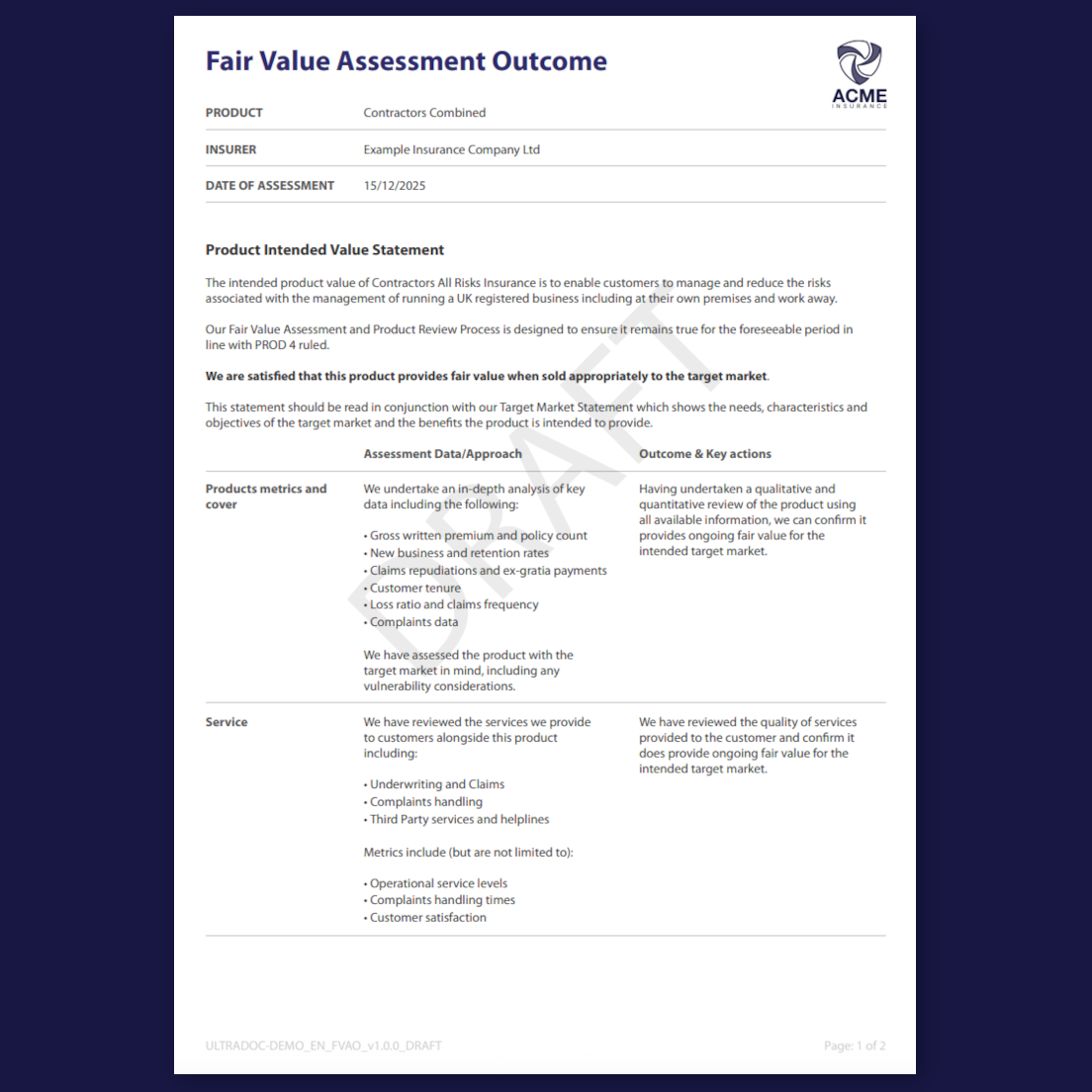
Fair value, properly documented.
So you can demonstrate it when asked.
Why it matters
Fair Value Assessment Outcomes evidence compliance with the FCA's Price and Value outcome under Consumer Duty. They are internal governance documents, shared with your board, distributors, and the regulator to demonstrate due diligence across the product lifecycle.
What goes in
A typical assessment covers product description, target market, pricing and costs, benefits analysis, distribution strategy, outcome analysis across customer segments, and governance and remediation plans.
Every section. Every time.
Product description
Nature of the product, its benefits, and its limitations, clearly documented.
Target market
Who the product is designed for, and who it is not designed for.
Pricing and costs
Total price to the customer, including fees, charges, and non-monetary costs such as time and effort.
Benefits analysis
Quality and benefits the customer can reasonably expect, using quantitative and qualitative metrics.
Distribution strategy
How remuneration across the distribution chain ensures fair value for the end consumer.
Outcome analysis
Differential outcomes across customer segments, including vulnerable customers, to ensure no group receives poor value.
Governance and remediation
Monitoring, review processes, and actions when a product is found not to provide fair value.
Ready to document your fair value assessments?
See how Ultradoc structures Fair Value Assessment Outcomes for Consumer Duty compliance, and keeps them aligned with product changes.