· Tristan Blackwell · Document Types · 6 min read
IPID vs Policy Summary vs Key Facts: Which Documents Do You Need?
IPIDs, Policy Summaries and Key Facts documents are frequently confused. Here's what each one is, which FCA rule requires it, and which one your product needs.

For general insurance sold to consumers, the FCA requires an IPID unless the specialist risks exemption applies. For pure protection products, it requires a policy summary. ‘Key Facts’ is a label, not a third legal document. Much of the confusion comes from firms using these labels interchangeably, and from rules that changed when the UK left the EU.
This guide sets out what each document is, which rule requires it, and how to work out which one your product needs.
The short answer
| IPID | Policy Summary | Key Facts | |
|---|---|---|---|
| What it is | Standardised pre-sale summary of a general insurance product | Pre-sale summary of the key terms of a policy | A logo and a common label, not a separate document type |
| Used for | General insurance sold to consumers, excluding specialist risks contracts | Pure protection contracts sold to consumers, and optionally commercial customers | Appears on policy summaries, and is often used as a name for product summaries |
| FCA rule | ICOBS 6 and ICOBS 6 Annex 3 | ICOBS 6.4 and ICOBS 6 Annex 2 | The Key facts logo requirement sits in ICOBS 6 Annex 2 |
| Who drafts it | The product manufacturer | Usually the insurer, under the ICOBS 6 responsibility rules | Same as the policy summary: the logo sits on that document |
| Format | Fixed structure, on two sides of A4 or three if it can be justified | Prescribed content and no other information | Key facts logo on the policy summary, not a separate format |
The IPID: general insurance for consumers
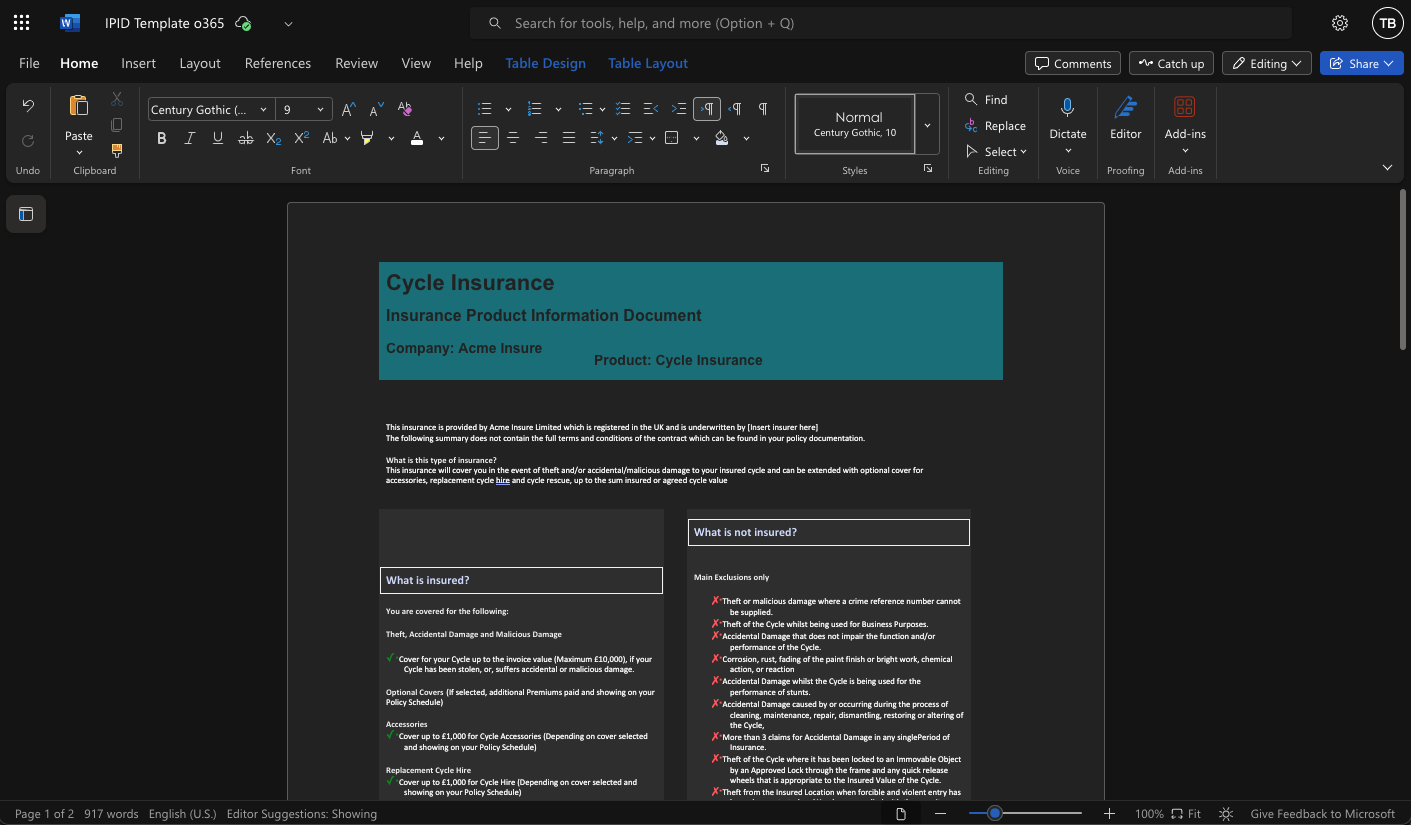
An Insurance Product Information Document (IPID) is a short, standardised summary of a non-life insurance product. Under ICOBS 6, a firm dealing with a consumer must provide the IPID information in the form of an IPID for each policy, other than a pure protection contract. The specialist risks exemption applies regardless of customer type, including consumers buying private aircraft insurance. Outside that exemption, this covers products such as home, motor, travel, pet and gadget insurance.
The IPID must be drawn up by the product’s manufacturer, and its format is strictly controlled. Under ICOBS 6 Annex 3, the UK version that has applied since 5 April 2024, an IPID must:
- Carry the title ‘insurance product information document’ at the top of the first page
- Show the manufacturer’s name and regulatory status immediately after the title
- State that the full pre-contract and contract information is provided in other documents
- Follow the standardised structure, headings and sequence
- Use a font with an x-height of at least 1.2 mm
- Fit on two sides of A4 when printed, or three sides exceptionally, with a justification the manufacturer can give the FCA
- Be written in plain language
Where the IPID requirement applies, an IPID is required for each individual policy, whether it’s sold on its own, alongside another policy, or with other goods or services. Our guide to what an IPID is explains the headings in more detail.
The policy summary: pure protection
Pure protection contracts are excluded from the IPID requirement. These include term assurance, critical illness cover and income protection. Instead, ICOBS 6.4 requires a firm to give the consumer a policy summary in good time before a pure protection contract is concluded.
The content of a policy summary is set out in ICOBS 6 Annex 2. It must be in writing or another durable medium, and it must contain the prescribed information and nothing else. That content includes a statement that the summary does not contain the full terms of the policy, the name of the insurer, the type of insurance and cover, and the significant features, benefits, exclusions and limitations.
ICOBS 6 Annex 2 also permits a firm to provide a key features document instead of a policy summary, provided it meets the relevant requirements.
Key Facts: a label, not a document type
‘Key Facts’ is the source of most of the confusion. It is not a third document that the rules require alongside the IPID and the policy summary. Under ICOBS 6 Annex 2, a policy summary must display the Key facts logo in a prominent position at the top. That’s where the name comes from.
Over time, many firms began using ‘Key Facts’ as a catch-all term for any short product summary, including documents that are in substance IPIDs. That’s why you’ll regularly see insurers referring to ‘Key Facts documents’ for general insurance products. The name matters less than whether the document actually meets the rules that apply to the product.
Commercial customers
For commercial customers who are not larger commercial customers, ICOBS 6 guidance allows a firm to provide the appropriate information in an IPID, a policy summary or another clear summary, including the IPID information where applicable. The ICOBS exclusion for larger commercial customers applies to general insurance, including specialist risks contracts (see ICOBS 1 Annex 1).
Scope was reduced further in December 2025. Under the FCA’s PS25/21, the IPID requirements no longer apply to specialist risks contracts, regardless of the type of customer.
Which documents does your product need?
Work through these questions:
- Is it a specialist risks contract? Check this exemption first: it removes the IPID requirement regardless of customer type, including for consumers buying private aircraft insurance. Check the remaining applicable disclosure duties.
- Is the customer a consumer? If not, check the commercial customer rules above, including the exclusion for larger commercial customers.
- For a consumer outside the specialist risks exemption, is it a pure protection contract? If so, the consumer needs a policy summary, or a compliant key features document. Otherwise, the consumer needs an IPID.
- What else does the product need? The IPID or policy summary is only one part of the pack. Most products also need a Target Market Statement and a Fair Value Assessment Outcome for distributors, and a Notification of Change when material terms change for existing customers.
Whatever the document is called, it has to be consistent with the policy wording. A summary that overstates the cover or omits a key exclusion is a consumer understanding issue under the Consumer Duty, whatever label it carries.
How Ultradoc helps
Ultradoc comes with templates for both the IPID and the Policy Summary and Key Facts, so each product gets the right document in the right format. Teams can generate a first draft from the policy wording, and AI consistency checking picks up where a summary no longer matches the source. Output is designed around PDF/UA, so the same document works for customers using screen readers.
This is a general overview, not legal or compliance advice. Check the current FCA Handbook for the rules that apply to your products.