· Tristan Blackwell · Regulation · 5 min read
Fair Value Is an FCA Enforcement Focus. What Your Fair Value Assessment Outcome Must Show
Fair value is at the heart of the FCA's Consumer Duty investigations. Here's what a Fair Value Assessment Outcome needs to give distributors, and the errors the FCA keeps coming across.

Fair value is an FCA enforcement focus under the Consumer Duty, and insurers are very much in scope. The Fair Value Assessment Outcome is the document that shows distributors, and ultimately the regulator, that your assessment was genuine. All too often, it is a single sentence.
This guide sets out why fair value is under such scrutiny, what a Fair Value Assessment Outcome must contain, and the errors the FCA has specifically identified.
Why fair value is under the spotlight
The FCA has been remarkably transparent about where its enforcement focus lies. In its first Enforcement Watch newsletter, published on 28 January 2026, it said it was investigating six potential Consumer Duty breaches, with a particular emphasis on fair value. Two of those concerned insurance firms, and the FCA described them as the most serious cases found in its multi-firm work.
By Enforcement Watch 2, published on 7 July 2026, the number of open Consumer Duty investigations had climbed to 11, across insurance, pensions, wealth management and other sectors. In several of the cases, the FCA said it was examining whether consumers had received fair value under the Consumer Duty and its PROD rules. It also repeated a point firms often miss: fair value is not simply about price. A product that fails to meet customers’ needs, or provides very little real benefit, is unlikely to be fair value, however it is priced.
Where the Fair Value Assessment Outcome fits
For non-investment insurance products, the fair value rules sit in PROD 4, alongside the Consumer Duty’s price and value outcome in PRIN 2A.4. The FCA has stated that complying with the PROD 4 fair value rules satisfies the Duty’s price and value outcome for these products.
Two obligations meet in the outcome document:
- Manufacturers must assess whether each product offers fair value to customers in its target market, and give distributors the information they need to understand the product’s intended value.
- Distributors must have arrangements in place to obtain that information, so they can understand the outcome of the assessment and identify any groups of customers for whom the product is not expected to offer fair value (PROD 4.3).
The Fair Value Assessment Outcome is where those two obligations come together. If it’s thin, both sides of the chain are exposed.
What the FCA keeps finding
The FCA’s 2024 product governance thematic review, TR24/2, looked at 28 manufacturers and 39 distributors. Its findings read like a checklist of what not to do:
- Ignoring the total price. Many assessments failed to take proper account of the total price the customer actually pays, including the impact of distributor remuneration.
- Unjustified commission. Fewer than five firms provided an appropriate justification for distributor remuneration, and very few had the data to monitor it.
- Empty outcome statements. Some manufacturers simply sent an email confirming an assessment had been carried out. Others just stated that the product offered fair value, with nothing more.
- Distributors carrying on regardless. Some distributors continued to sell products despite clear gaps in the information they had received.
- Very little action. Very few products were suspended or withdrawn on fair value grounds.
These are not new warnings. As far back as 2022, the FCA told general insurance and pure protection firms that a generic web-based outcome statement might not give distributors enough information.
What a Fair Value Assessment Outcome should include
There is no prescribed FCA template, but a strong outcome document gives the distributor everything it needs to understand the conclusion and its own role. A practical structure:
| Section | What to include |
|---|---|
| Product details | Product name, version, manufacturer, and the date of the assessment |
| Target market | A short summary of who the product is for, linked to the full Target Market Statement |
| Intended value | The benefits and service the product is designed to deliver, including non-financial benefits |
| Total price | Premium, add-ons, fees and charges, and any premium finance costs |
| Distribution remuneration | How commission and other remuneration were assessed, and why they are consistent with fair value |
| Evidence considered | The MI behind the conclusion, such as claims frequency and acceptance rates, loss ratios, complaints, and cancellations |
| Groups at risk of poor value | Any customers for whom the product is not expected to offer fair value, and why |
| Conditions for distributors | Anything distributors must do, or avoid, to keep the product fair value, such as limits on added fees |
| Outcome and actions | The conclusion, plus any actions taken or planned |
| Review | The next review date and what would trigger an earlier one |
Write it for a busy distributor’s product team. They need the conclusion, the reasoning and their obligations in one place, not the full internal assessment.
Keep the outcome in step with the product
A Fair Value Assessment Outcome becomes out of date the moment the product, price or distribution changes. Since PS25/21, manufacturers have had to set their own product review frequency in line with the potential for customer harm, so outcome documents need to follow each product’s cycle rather than one annual review. Our guide to setting a product review frequency explains how to do that.
It also has to be consistent with everything else. If the IPID describes one set of benefits, the Target Market Statement another and the outcome document a third, the distributor can’t rely on any of them.
How Ultradoc helps
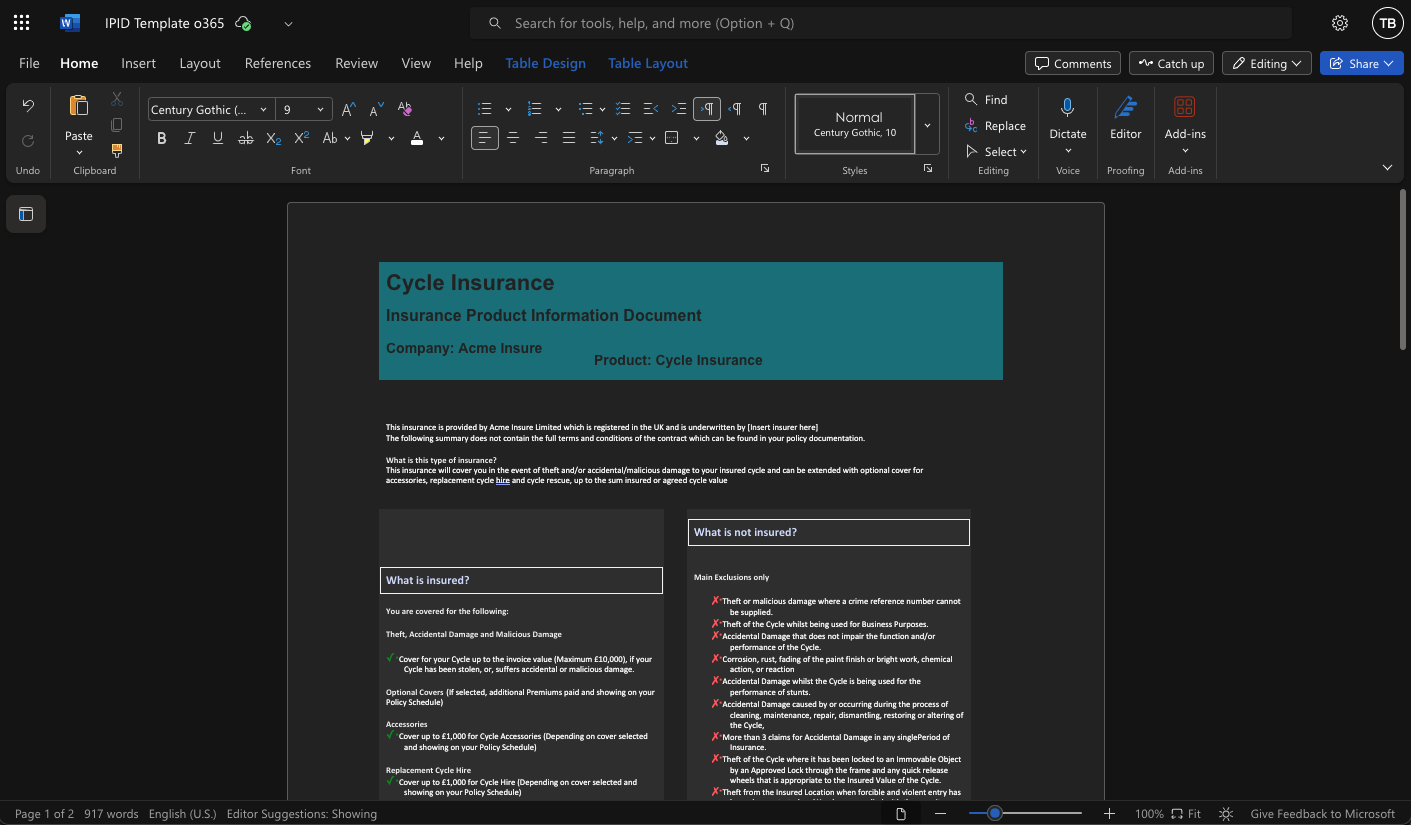
Ultradoc’s Fair Value Assessment Outcome template gives every product the same structure, so nothing a distributor needs is left out. Reusable content blocks keep product details consistent across the outcome document, the Target Market Statement and the IPID, with AI consistency checking picking up any divergence. There is a complete audit trail of every change and approval.
This is a general overview, not legal or compliance advice. Check the current FCA Handbook and your own obligations.