· Tristan Blackwell · Regulation · 6 min read
The 12-Month Product Review Has Gone. How Often Should You Review Now?
The FCA has removed the mandatory 12-month review for non-investment insurance products. Here's how to set a review frequency that you can actually defend, and what that means for your product documents.

Insurers are no longer required to review every non-investment insurance product at least once every 12 months. Since the FCA’s PS25/21 came into effect on 9 December 2025, manufacturers must determine the review frequency for each product based on its potential to cause harm to customers, and set out the reasons for the frequency they have chosen.
That sounds like less work. In reality it means more judgement, more evidence and a harder question when the FCA asks why a product has gone 18 months without a look. This guide looks at what changed, how to set a frequency that you can actually defend, and what it means for the documents that sit around each product.
What changed in PS25/21
Before December 2025, PROD 4 required manufacturers to review their non-investment insurance products at least every 12 months. Every product went through the same annual cycle, regardless of whether it was a high-volume add-on sold through price comparison sites or a niche product with stable claims and virtually no complaints.
PS25/21 replaced that fixed minimum with a risk-based approach. Manufacturers must now:
- Set the review interval for each product according to the potential for customer harm arising from that product’s risk factors.
- Keep the interval under review on an ongoing basis. The FCA has said that firms are responsible for updating the frequency where their own data suggests that the risk of harm has changed.
- Record the decision and the rationale for it.
- Share review-frequency information on request with other firms in the distribution chain.
The FCA also restated that product reviews are the sole responsibility of the manufacturer. Distributors review their own distribution arrangements, so their timescales can legitimately differ from the manufacturer’s.
Flexible does not mean less often
The removal of the 12-month minimum works in both directions. A product with a high potential for harm might need reviewing every six months, or straight away if anything changes. A straightforward, stable product could justify a longer cycle.
It’s worth bearing in mind where the FCA started from. In its 2024 product governance thematic review, TR24/2, it found that some firms were not even meeting the old annual requirement. Firms that simply use the new flexibility to review less will find that approach very difficult to justify, particularly with fair value now such a key enforcement theme under the Consumer Duty.
How to set a review frequency you can defend
There’s no single formula. Under PROD 4.2.36AB, manufacturers must consider at least the nature of the customer base, including significant numbers of long-tenure or vulnerable customers; indicators of customer harm in the fair value assessment; and indicators of customer harm emerging from product performance, for example through claims and complaints data. These factors are required in addition to those in PROD 4.2.36R.
A practical approach is to score each product against a consistent set of risk factors, put it in a tier and attach a default interval to each tier. Supplementary examples to consider alongside the required factors include:
- Product complexity, including optional covers, limits, and how easy the product is to understand
- Target market, particularly mass-market products and those with a higher share of customers in vulnerable circumstances
- Distribution, including the number of distributors, add-on and packaged sales, and remuneration levels
- Customer outcome data, such as claims acceptance rates, complaints, cancellations, and renewal behaviour
- Pricing, including recent price changes and premium finance
- Product age, since newly launched products have no track record yet
- Recent change, whether to the policy wording, the underwriting, or the regulation
An illustrative tiering model might look like this:
| Tier | Typical profile | Example default interval |
|---|---|---|
| Higher harm | Mass-market or add-on products, complex cover, high remuneration, weak or worsening outcome data, newly launched | 6 months, or sooner when triggered |
| Standard | Established products with stable data and simple distribution | 12 months |
| Lower harm | Simple products, narrow target market, strong long-run outcome data | Up to 24 months, with event triggers |
The intervals above are examples only, not FCA guidance. What’s important is that your criteria are properly documented, applied consistently and linked to evidence.
Add event triggers to every interval
A calendar interval is only half the answer. Each product also needs triggers that start an immediate review, regardless of what the schedule says. Common triggers include:
- A change to the policy wording, cover, limits, or exclusions
- A pricing change or a new premium finance arrangement
- A spike in complaints, cancellations, or declined claims
- A new distributor or a change in remuneration
- New FCA rules, guidance, or findings that affect the product type
Triggers are what make a long interval credible. A 24-month cycle without any triggers is just a long gap.
Record the rationale, not just the date
PS25/21 requires firms to record their review-frequency decision. A useful record covers:
- The product and version
- The risk factors considered and the tier assigned
- The resulting interval and the triggers attached to it
- Who approved the decision, and when
- When the interval itself will next be reconsidered
Keep this alongside the product’s review history, so that the decision, the evidence and what happened at each review are all in one place for anyone to see.
What this means for your product documents
A product review isn’t complete until the documents surrounding the product reflect its outcome. When a review leads to a change, check every affected document:
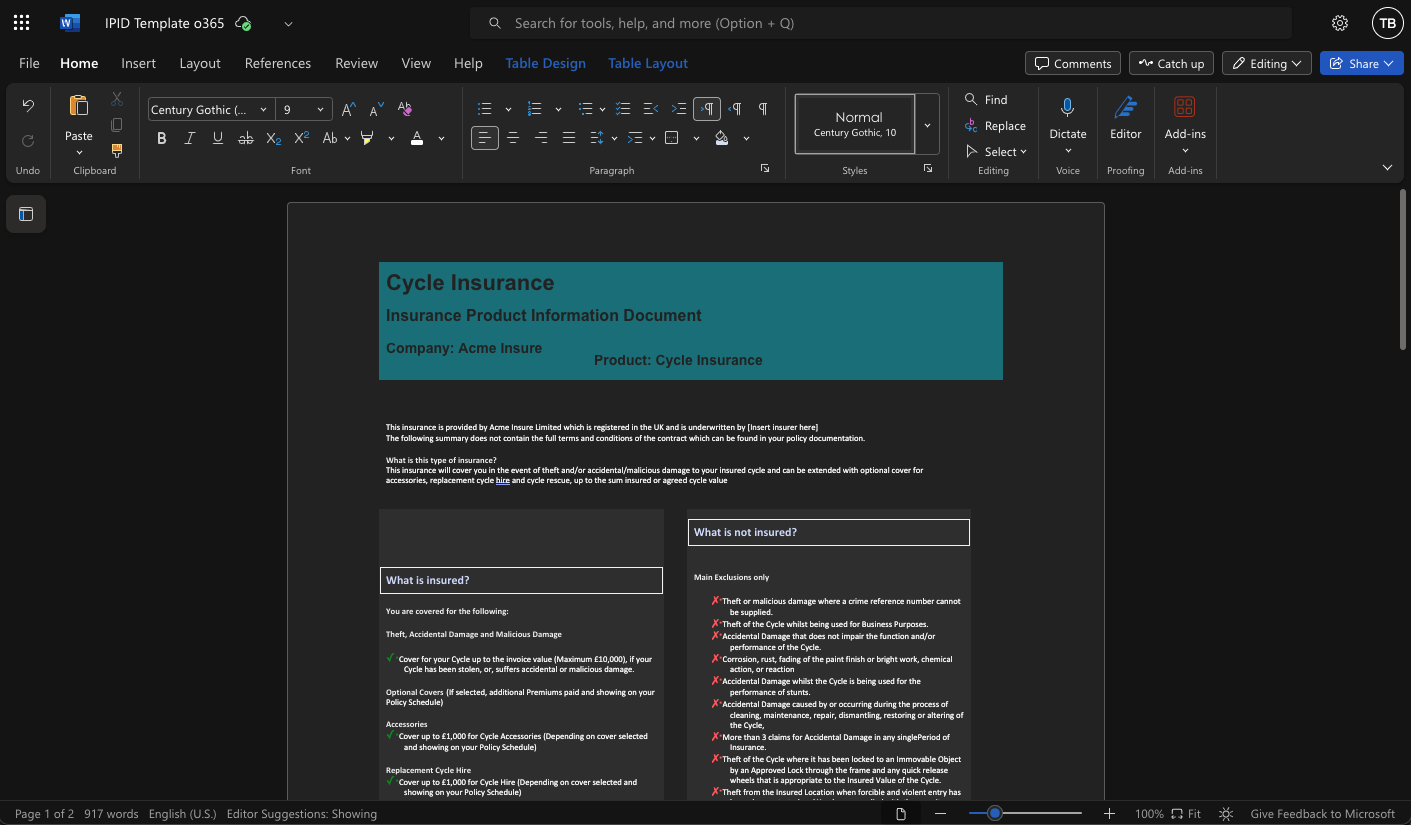
- IPID and Policy Summary or Key Facts documents, so customer-facing summaries still match the cover
- Target Market Statement, if the intended customers or distribution strategy have changed
- Fair Value Assessment Outcome, so distributors receive the current conclusion
- Notification of Change, if existing customers need to be told about material changes
With different products now on different cycles, it becomes much harder to keep track of which documents are due for review, who owns them and whether they still agree with each other. A spreadsheet that was perfectly adequate when everything ran on one annual cycle will quickly break down.
How Ultradoc helps
Ultradoc’s review and governance tools give each document a clear owner, a review deadline and automated reminders, so a different interval for each product doesn’t mean losing track. There’s a complete audit trail of every edit, approval and sign-off, and AI consistency checking picks up where an IPID or Policy Summary no longer matches the policy wording after a change.
This is a general overview, not legal or compliance advice. Check the current FCA Handbook and your own obligations before changing your product governance approach.